
North Korea has a predetermined place in the dictionary of Western strategy analysis; the unreasonable outcast, the “rogue state” whose nuclear intentions are symptomatic of sickness instead of policy. It is not just analytically lazy framing, but it is strategically perilous. It preempts any real confrontation with what Pyongyang is in fact doing and why its missile program, through the prism of the classical deterrence theory, has its own logic, no less coherent than that of any great power.
The finest instance of this is the Hwasong ICBM series. After the development of liquid-fueled Hwasong-15 and followed by the solid-fueled Hwasong-18 and later Hwasong-19 and 20, within a reduced period of time, North Korea has ended up with a strategic deterrent that has actual second-strike capability. It is to misunderstand the signal to reject this as the actions of a “rogue actor.”
A History That Precedes the Missile
One must consider how much was done on North Korea before analyzing what it has constructed. In 1950–53, the American airpower carried out one of the most intensive bombardment campaigns in the history of modern military against the Korean peninsula. Practically all major cities in the North were burned down. Civilians and civilian infrastructure were targeted systematically and indiscriminately, including dams and factories. In the crude evaluation of U.S. Air Force General Curtis LeMay, the nation was bombed “back to the stone age.” There was no formal signing of a peace treaty. The US troops stayed in the peninsula. The resultant sanctions architecture was not a reaction to the North Korean nuclear program, it pre-dates it, influences it, and in considerable part, creates it.
It is not a defense history, it is informative. The deterrence theory should have been applied on the threat environment in which it was placed, not the one that was desirable to others. The North Korean experience has been witnessing the US destroy Iraq on the false assumption of weapons which it never had, and Libya following the death of Muammar Gaddafi who voluntarily abandoned his nuclear program to gain normalization. The lesson that Pyongyang took from those two instances was that security of sovereignty in the face of the superior power of the US army, must have an uncompromising deterrent. If that is the case of the “recklessness”, the accusation must be against all the nuclear powers, even those who have drafted the Non-Proliferation Treaty, and possess their own stockpiles. The idea of the definitional inequality in “rogue state” is not international law. It is the hegemonic discourse. Washington defined and filled the category. That was not the name that was chosen by Pyongyang but rather one which was given.
The Survivability Imperative
It was not a technological stunt to change the liquid into solid propellant, a feature that characterized the Hwasong-18 when it was initially tested in April 2023. It was a direct response to the oldest nuclear strategy issue: vulnerability. Missiles that are liquid fueled take hours to prepare, leaving visible evidence of their plans, fuel trucks, support vehicles, launch crews, which open windows by which they can be interdicted. Solid-fuel missiles do not need to be refueled, minimizing the logistical effort needed to deploy the system, and eliminating the significant ease of overhead surveillance. That is, Pyongyang worked out the preemptive strike issue in the same manner that Moscow and Washington had done previously.
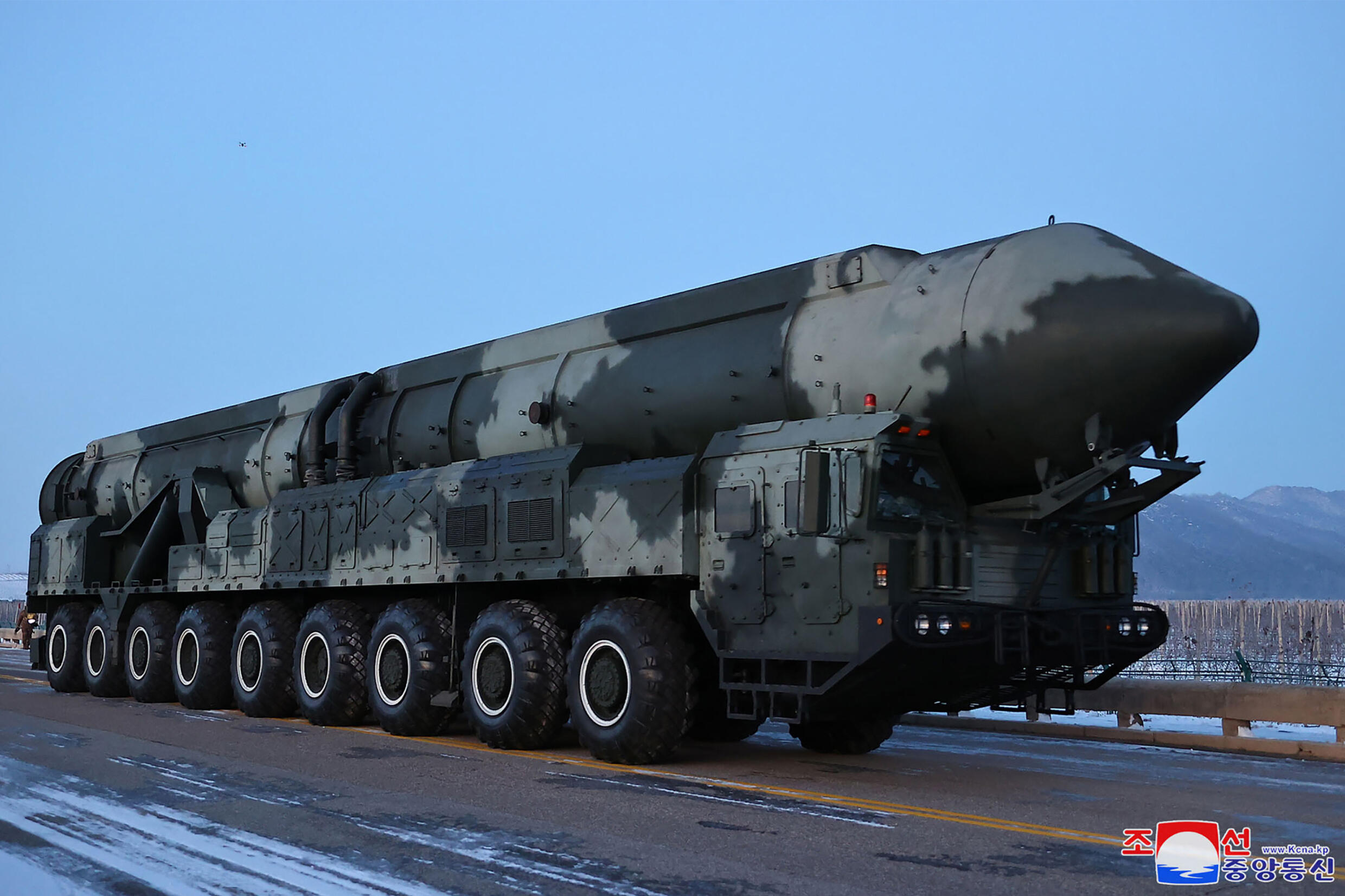
This trend continued in the first test of the Hwasong-19 in October 2024. It is now the world’s longest road-mobile ICBM and is 28 meters long. During the test, the missile reached an altitude of more than 7,600 kilometers, which is consistent with a missile which is to be used for continental ranges. It was followed by the Hwasong-20 unveiled in the October 2025 parade, which was described by the official media as the military’s “most powerful nuclear strategic weapon system” with a wider diameter airframe, and a rounded fairing, which was seen as the structural design of multiple independently targetable reentry vehicles (MIRVs).
Its mobility enables the Hwasong-20 to be more difficult to be intercepted, its solid-fueled fueling enables it to be launched faster than conventional liquid-fueled missiles, and its probable MIRV capability indicates it could theoretically overwhelm existing missile defenses with a series of warheads, which could be launched by a single launch. Such are not the features of a machine constructed to be “reckless.” They are the features of a system that have been designed to be able to withstand the first strike and be able to retaliate back in its own capacity, the very basis of a credible deterrent.
Decoupling Washington from Seoul
To understand the regional importance of the Hwasong series, the strategy problem the Hwasong series seeks to solve, must be understood. North Korea’s enemies are South Korea and the United States Forces Korea (USFK). It bears the brunt of the sustained deterrence posture that the US has crafted in the Indo-Pacific, which formally proposes to retaliate against an attack on Seoul as an attack on Washington.
The ICBM program threatens this commitment. Pyongyang is crafting what is known as a “decoupling effect” by creating the capacity to target the continental US with solid-fueled and MIRVed missiles: the threshold of confrontation with Washington will be raised to a point where its deterrence commitment will be questioned. The argument is not new as French strategists have had the same question about American extended deterrence in the Cold War era, whether the US would risk New York to protect Paris. This is the question that North Korea is asking, but with more lethal assets.
The Hwasong- 20 buttresses in the North Korean policy of threatening the mainland USA to alter the cost-benefit calculation and the strategic stand of the whole Indo-Pacific region. When a state has the capability to threaten the territory of the opponent, the pledge of extended deterrence is not an unconditional but a conditional guarantee, and allies understand this very well.
The Regional Cascade
This logic has already started to transform the East Asian defense structure and the impacts are cumulative. South Korea has also ramped up its own ballistic missile program. The defense minister of Seoul has described the Hyunmoo-5 as a ‘bunker buster’ which can provide a ‘balance of terror’ to deter North Korea and the defense officials have hinted that a volley of fifteen to twenty such missiles would have a devastating effect equivalent to a nuclear warhead. Japan has increased its defense budget to 2 percent of GDP, and it is building counterstrike capabilities, a strategic mark it had not reached since 1945. Taiwan observes such developments with its own calculations. The arms dynamic of the region is heating up not due to irrationality of North Korea but due to its rationality.
The missile defense aspect is also important. The result of a potential MIRV capability would place an enormous burden on missile defense batteries in the region, such as THAAD, Aegis Ashore, and the Patriot PAC-3 batteries that are designed to deal with a single warhead and would be unable to cope with a saturation attack. The incentive to proliferate (rather than restrict) increases when the investment of one side threatens the other. It’s a systemic rather than psychological question.
Deterrence, Not Aggression
The continuing Western tendency to demonize the strategic decision making of the North Korean government comes at a cost other than that of intellectual accuracy: it will deny the policy options that, in turn, will deny the stability. If we think of North Korea as an actor that is incapable of making deterrence calculations, then the application of deterrence would be ideologically unacceptable, and the only two options would be coercion or regime change, both of which would be disastrous.
The case of the Hwasong series is different. It is defined by a regime which has assessed its environment with remarkable accuracy, has identified its weakness, regime survival in the face of a military superior enemy, and has responded with a program which is designed to raise the cost of aggression. Even those skeptical of North Korean claims about the technical aspects of its program accept that what North Korea says it will do, it is likely to achieve. The logic of aggression is not the logic of the program. It is the logic of deterrence, the logic which has ruled nuclear strategy since 1945.
There is a shift in the east Asian defense balance. The question whether it will stabilize or escalate, will depend on whether major powers will engage North Korea as a state with comprehendible interests, or as an irritant to be contained. The latter presupposes the realization of the unpleasant fact that the conditions under which Hwasong missile was developed, were not developed in DPRK, they were constructed in Washington. History does not absolve states from their choices, rather it explains them. Solemn strategy should commence with explanation, not criticism.

Muhammad Mahad Samija
Muhammad Mahad Samija is a student at the Department of Political Science, Government College University Lahore.

Syed Jehangir
Syed Jehangir is a student at the Department of Political Science, Government College University Lahore (GCUL).