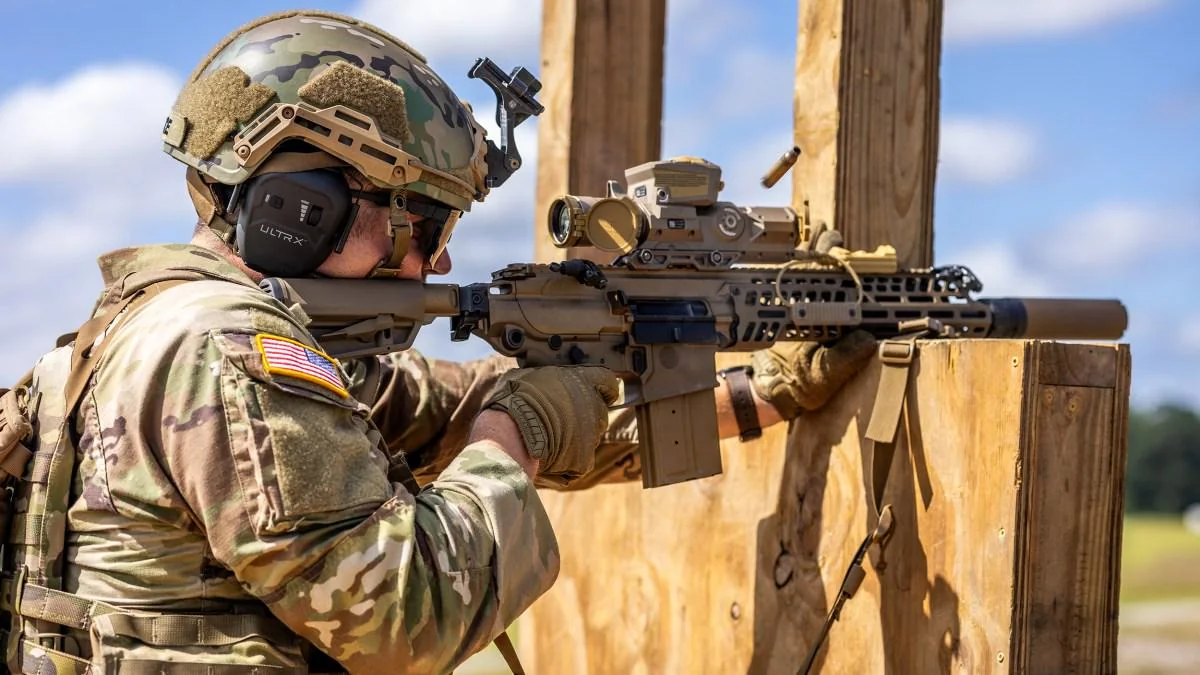

The U.S. Army’s adoption of the SIG Sauer M7 rifle represents one of the most significant changes to American infantry small arms in decades. The weapon is the product of the Next Generation Squad Weapon (NGSW) program, which sought not simply to produce another improved 5.56 mm carbine, but to address a fundamental question: could the traditional 5.56 mm infantry rifle provide sufficient range, penetration and terminal performance against modern threats?
The answer led the Army toward an entirely new weapons-and-ammunition system built around the 6.8×51 mm cartridge.
In April 2022, the Army selected SIG Sauer’s NGSW system following an extensive competitive evaluation. The rifle initially carried the designation XM5 but was subsequently type-classified as the M7 in 2025. The Army is now fielding the M7 within the Close Combat Force as the replacement for the M4A1.
From the M16 to the M4 — and finally the M7
The story of the M7 is easier to understand when viewed as an evolution of the American infantry rifle. The M16 entered U.S. Army service in the 1960s and established the 5.56×45mm cartridge as the Army’s standard small-arms ammunition. Its lighter cartridge allowed soldiers to carry considerably more ammunition than they could with the heavier 7.62×51mm ammunition used by the preceding M14.
The M4/M4A1 subsequently evolved from the M16 family into a shorter carbine better suited to mechanized infantry, urban combat and soldiers operating in confined environments. The basic philosophy remained unchanged:
5.56 mm → lightweight ammunition → high ammunition carriage → controllable automatic fire
That philosophy worked extremely well for many decades. However, the Army identified a different problem emerging in the 21st century: infantry engagements were increasingly taking place at distances where the combination of 5.56 mm ammunition and conventional optics could become a limitation.
The Army’s 2017 Small Arms Ammunition Configuration Study identified capability gaps, and the NGSW program was subsequently established to address them. The objective was to restore an advantage in range, accuracy, penetration and terminal effects, particularly against modern protected targets.
Why replace the M4A1?
The important point is that the Army didn’t conclude that M4A1 was simply unreliable or obsolete. Rather, the M4 had reached the limits of what could reasonably be obtained from its basic design and 5.56 mm ammunition. Three major problems drove the requirement for something different.
- Range and target effects
The 5.56×45mm cartridge was designed around a relatively lightweight projectile and comparatively low recoil. That provides excellent controllability and ammunition efficiency, but it also limits the amount of energy available at extended ranges compared with a larger, higher-energy cartridge. The Army wanted an infantry weapon capable of maintaining greater effects at longer distances. The NGSW program, therefore, moved away from simply improving the rifle and instead developed a new rifle + new ammunition + new optic + suppressor system.
- Modern body armor
Another consideration was the proliferation of improved personal protection. The Army’s requirement was not merely to defeat unprotected personnel. NGSW was developed around the requirement to engage personnel equipped with modern body armor as well as unprotected targets. This fundamentally changes the small-arms equation.
Instead of asking: How can we make the 5.56 mm M4 better? The Army effectively asked: What cartridge and weapon combination gives an infantryman substantially greater capability against the threats expected in future combat? That led to the 6.8mm system.
- Optics have become part of the weapon system
The M4 was traditionally a rifle to which an optic was added. The M7 takes the opposite approach. The rifle, suppressor, ammunition and M157 NGSW Fire Control are designed as an integrated system.
The M157 is a 1–8x optic incorporating technologies including a laser rangefinder and ballistic computation. The system can account for distance and environmental conditions to provide a corrected aiming solution. This is arguably as important as the rifle itself.
The 6.8×51mm cartridge
The biggest change is not actually the rifle. It is the ammunition. The M4/M16 family uses 5.56×45 mm NATO. The M7 uses 6.8×51 mm. The SIG SAUER-developed ammunition is associated with the .277 SIG FURY / 6.8×51 mm family and uses a hybrid metallic case designed to tolerate significantly higher chamber pressures than conventional ammunition. The increased pressure allows higher projectile velocity and energy without requiring an excessively long or heavy barrel. SIG SAUER’s commercial documentation identifies 135-grain and 150-grain projectile configurations for the .277 FURY family, although military ammunition configurations should not simply be assumed to be identical to commercial loads.
The important engineering principle is straightforward:
higher allowable pressure → higher velocity → greater retained energy → greater potential range and target effect.
The Army describes the 6.8mm ammunition family as providing increased range, accuracy and lethality compared with the legacy system. However, there is a trade-off.
A larger, more energetic cartridge inevitably means more ammunition weight and greater weapon-system mass than a conventional 5.56mm carbine. Army testing has specifically identified the additional weight of the M7 and its 6.8mm ammunition as a consideration for soldiers carrying a full combat load.
M16 vs M4A1 vs M7
| Characteristic | M16 | M4A1 | M7 |
| Basic role | Service rifle | Carbine | Next-generation rifle |
| Cartridge | 5.56×45 mm | 5.56×45 mm | 6.8×51 mm |
| Operating concept | Direct impingement | Direct impingement | Gas piston |
| Magazine | 30 rounds typical | 30 rounds typical | 20 rounds |
| Stock | Fixed/collapsible depending variant | Collapsible | Folding/collapsible |
| Controls | AR-pattern | AR-pattern | Ambidextrous AR-derived |
| Suppressor | Generally optional | Optional | Integral to system concept |
| Optic concept | Separate accessory | Separate accessory | M157 integrated fire-control system |
| Primary Army replacement relationship | Legacy | Direct predecessor | Current replacement for M4A1 in CCF |
| Design emphasis | Lightweight rifle | Mobility | Range, lethality, modularity |
The M7 therefore isn’t simply a heavier M4. It represents a change in the entire infantry small-arms architecture.
Modern ergonomics
SIG SAUER based the M7 on the MCX/SPEAR architecture, retaining familiar AR-style controls while introducing several changes intended to improve manipulation. The rifle uses a fully ambidextrous control layout, a free-floating M-LOK handguard, folding/collapsible stock and both rear and side charging arrangements. The side charging handle is particularly significant.
On a traditional AR-15/M16/M4 design, the charging handle is located at the rear of the receiver. The M7 incorporates a non-reciprocating side charging handle, giving the soldier another method of manipulating the action while maintaining a firing position. Soldiers participating in Army evaluations specifically identified the side charging system and overall ergonomics as advantages during movement and weapon transitions.
The folding stock is another major difference. A conventional M4 stock collapses along the receiver axis, whereas the M7’s folding architecture allows the rifle to become substantially more compact for transport and vehicle operations. The M7’s 13-inch barrel also allows the Army to retain a relatively compact weapon while exploiting the performance of the 6.8×51 mm cartridge.
The M7’s operating system
Unlike the traditional direct-impingement AR-15/M16/M4 family, the M7 uses a short-stroke gas-piston operating system with a rotating bolt. This is particularly relevant when the rifle is suppressed.
The Army’s NGSW concept treats the suppressor as part of the weapon system rather than merely an optional accessory. SIG’s SLX suppressor is designed to reduce sound and flash while controlling the amount of propellant gas returning toward the shooter. The result is a more integrated package.
M7 + 6.8 mm ammunition + suppressor + M157 fire control.
That is considerably different from the traditional
M4 + 5.56 mm ammunition + separately selected optic + optional suppressor.
The M7 and the weight problem
One of the interesting contradictions of the M7 is that it provides substantially greater ballistic capability, but it does so with a heavier rifle and ammunition load. The Army acknowledged during the NGSW program that the M7 rifle is approximately two pounds heavier than the M4 when comparing unloaded weapons.
SIG’s published specifications for the closely related MCX-SPEAR identify an unloaded 6.8×51 configuration at approximately 8.38lb, although military M7 configuration weights vary depending on the exact configuration and accessories.
And that is before adding:
- M157 fire-control optic
- suppressor
- loaded magazine
- laser/other accessories
- sling and ancillary equipment
Consequently, the M7 is not trying to beat the M4 by being a lightweight carbine. It is trying to provide substantially more capability per shot. That distinction is important.
The M157 changes the equation
Perhaps the most technologically significant component of the M7 system is the M157 NGSW Fire Control. The optic provides magnification from approximately 1x to 8x, while integrating a laser rangefinder, aiming lasers and ballistic computation. This creates a fundamentally different engagement process. With a conventional rifle:
detect target → estimate range → adjust aim → fire
With the M7 system:
detect target → range target → fire-control system calculates solution → corrected aiming point → fire
The soldier still makes the decision to fire, but much of the ballistic calculation can be handled electronically. This is particularly important because the 6.8×51mm cartridge operates at significantly different ballistic characteristics from 5.56mm. The rifle therefore becomes part of a broader sensor-to-shooter system rather than simply a mechanical firearm.
Why not simply use 7.62×51 mm?
This is an important question. The Army already had a powerful cartridge, 7.62×51 mm NATO. So why introduce 6.8×51mm? The answer lies in trying to occupy the middle ground. 7.62mm provides considerable ballistic performance but comes with substantial ammunition weight and weapon-system penalties. 5.56 mm provides excellent ammunition efficiency and controllability but has limitations in the Army’s desired future engagement envelope.
The 6.8×51mm concept attempts to provide considerably greater performance than 5.56mm while using a purpose-designed rifle that remains more manageable than a traditional full-power 7.62mm infantry rifle. The Army specifically required the NGSW rifle to remain lighter than comparable 7.62mm systems during the competition.
Fielding the M7
The transition has already moved beyond the prototype stage. SIG Sauer received the Army’s NGSW production contract in April 2022 following an extensive competition and evaluation program. The Army subsequently conducted technical testing, Soldier evaluations and environmental testing.
By May 2025, the M7 had received Type Classification–Standard, removing the experimental “X” designation. The Army stated in 2026 that the M7 was being fielded across the Close Combat Force as the replacement for the M4/M4A1. Environmental testing has included extreme cold and desert conditions, while operational exercises have examined issues ranging from weapon reliability to vehicle ingress/egress and tactical employment.
Interestingly, the Army is also developing the XM8, a shorter and lighter carbine derived from the M7. The XM8 is intended for soldiers for whom the full-length M7’s size and weight present mobility disadvantages. That development illustrates an important lesson from the M7 program: increased ballistic performance comes with physical costs, and not every soldier necessarily requires the same weapon configuration.
A generational change rather than another rifle replacement
The M7 should therefore not be viewed simply as:
M16 → M4 → M7.
That makes the transition appear much more straightforward than it is. The real progression is closer to:
M16/M4 + 5.56 mm + conventional optics → M7 + 6.8×51 mm + suppressor + computerized fire control
The difference is technological as much as ballistic. The M16 established the modern American 5.56mm rifle concept. The M4 refined that concept for mobility and close combat. The M7 represents an attempt to redesign the infantry weapon around the requirements of a battlefield in which longer engagement distances, modern body armor, advanced optics, suppressors and near-peer competition all matter simultaneously.
The Army has consequently accepted a heavier weapon and heavier ammunition burden in exchange for greater range, accuracy and target effects. Official Army testing and field exercises continue to evaluate whether those advantages justify the additional weight and logistical demands over sustained service.
The significance of the M7 is therefore not merely that the United States has adopted a new rifle. It is that the Army has changed its underlying philosophy of what a squad rifle should be.
After roughly six decades in which the M16/M4 family and 5.56mm ammunition defined the American infantry rifle, the M7 introduces a new model: a higher-energy cartridge, a suppressor, an integrated ballistic fire-control system and a modular rifle designed together as one weapon system. That makes the M7 one of the most consequential American small-arms programs since the original transition to the M16.