
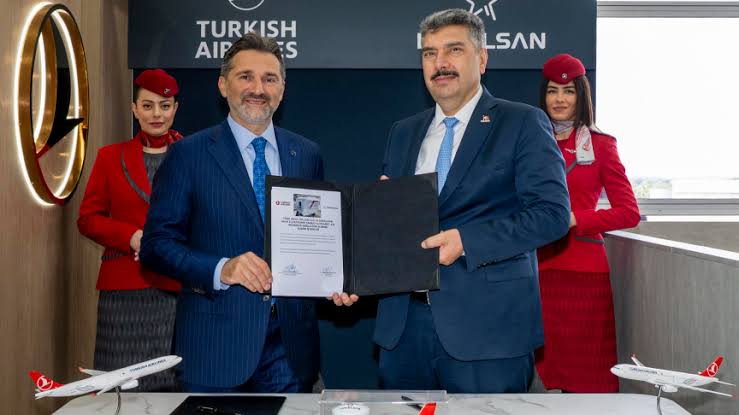

Turkish Airlines has signed an agreement with HAVELSAN for 12 new flight simulation training devices as the carrier expands its pilot training infrastructure in support of its long-term fleet growth plans.
The agreement covers eight Full Flight Simulators, or FFS, and four Flight Training Devices, or FTD. The systems will support Turkish Airlines’ plan to expand its fleet beyond 800 aircraft by 2033 while increasing the capacity of its flight training operations.
Under the agreement, HAVELSAN will supply simulators for both narrow-body and wide-body aircraft. The contract also marks the Turkish technology company’s entry into the wide-body aircraft simulation market.
All 12 training devices will be manufactured in Türkiye and integrated into Turkish Airlines’ expanding training infrastructure. According to the company, the project will contribute to the development of Türkiye’s domestic aviation technology and indigenous pilot training capabilities.
Table of Contents
ToggleTurkish Airlines expands pilot training capacity
Turkish Airlines is developing new simulator hangars and a larger training infrastructure to support the expansion of its aircraft fleet and operational network.
Construction of the new simulator facilities began in January 2026. The first phase is expected to become operational in 2027, while a new Flight Training Center is planned for completion in 2028.
The airline expects its Flight Training Center to become one of Europe’s largest aviation training facilities by 2033. The expanded center will operate across three campuses and provide training services not only for Turkish Airlines pilots but also for personnel from other airlines.
Turkish Airlines Chairman of the Board and Executive Committee Prof. Murat Şeker said the new orders would support the airline’s ambition to build a major flight training center while strengthening Türkiye’s domestic aviation ecosystem.
“With these new orders, by 2033 the Turkish Airlines Flight Training Center will become one of Europe’s largest flight training centers across three campuses, meeting the needs of Turkish Airlines while also providing training services for other airlines,” Şeker said.
HAVELSAN enters wide-body simulator market
The contract represents a significant expansion of HAVELSAN’s civil aviation simulation portfolio.
HAVELSAN has previously supplied training systems for narrow-body aircraft, including Airbus A320 and Boeing 737 platforms. The new agreement will allow the company to deliver flight simulators covering both narrow-body and wide-body aircraft types.
HAVELSAN CEO Dr. Mehmet Akif Nacar described the agreement as an important milestone for the company.
“This agreement marks an important milestone as it represents HAVELSAN’s entry into the wide-body flight simulation market,” Nacar said. “We remain committed to delivering advanced, high-quality simulation solutions that support excellence in pilot training.”
Existing HAVELSAN simulators at Turkish Airlines
Turkish Airlines currently operates six HAVELSAN-manufactured Full Flight Simulators certified to European Union Aviation Safety Agency Level D standards.
The existing systems include:
- Three Airbus A320neo/CEO Full Flight Simulators
- Two Boeing 737 MAX Full Flight Simulators
- One Boeing 737NG Full Flight Simulator
HAVELSAN has also completed the EASA certification process for a Boeing 737 MAX Full Flight Simulator ordered by Turkish Airlines during the 2025 Paris Air Show.
Level D certification is the highest standard for Full Flight Simulators and enables airlines to conduct advanced pilot training with highly realistic cockpit, aircraft movement and flight-performance replication.
The latest order reflects Turkish Airlines’ continued use of domestically manufactured simulation systems as it prepares for a substantial expansion of its fleet, route network and pilot workforce.
Turkish Airlines currently operates 556 passenger and cargo aircraft and serves 358 destinations across 133 countries, according to the company.












