
A recent newspaper article framed the Türkiye–Saudi visa-waiver agreement as another sign that Pakistan had been “skipped” despite the emergence of the Makkah Joint Defence framework. It’s a involving frame and it’s the wrong lens. Carefully, the visa waiver is not a snub! It is a minor but significant component of a broader security architecture that is developing in three of the most powerful Muslim states. The bottom line for defence analysts is how the three factors, mobility, institutions and military cooperation, are beginning to feed into each other.
The Waiver’s Purpose
The facts are more limited than the headline would imply. The agreement was signed by Foreign Ministers Hakan Fidan and Prince Faisal bin Farhan during their meeting in Ankara on 6th May 2026. It was green-lighted by the Turkish government in June and by the Saudi Cabinet, led by Crown Prince Mohammed bin Salman, this month. It applies only to those who hold diplomatic and special passports, and they can enter, pass through and remain in the country for up to 90 days in every 180-day period. This doesn’t include regular travellers.
That detail matters. This isn’t a mass-tourism tool – this is an access tool for the office and institutions. It’s a tool that allows the minister, military envoys and technical teams to move fast without facing delays in paperwork. It also doesn’t isolate Pakistan either. Pakistan’s Deputy PM and Foreign Minister Ishaq Dar signed with Prince Faisal for the same categories of passports in September at the UNGA sidelines. That is, Riyadh has granted the same facility to both partners. When the events in the story unfold, the “skip” is lost.
The Defence Context: Bilateral Pact to Trilateral Framework
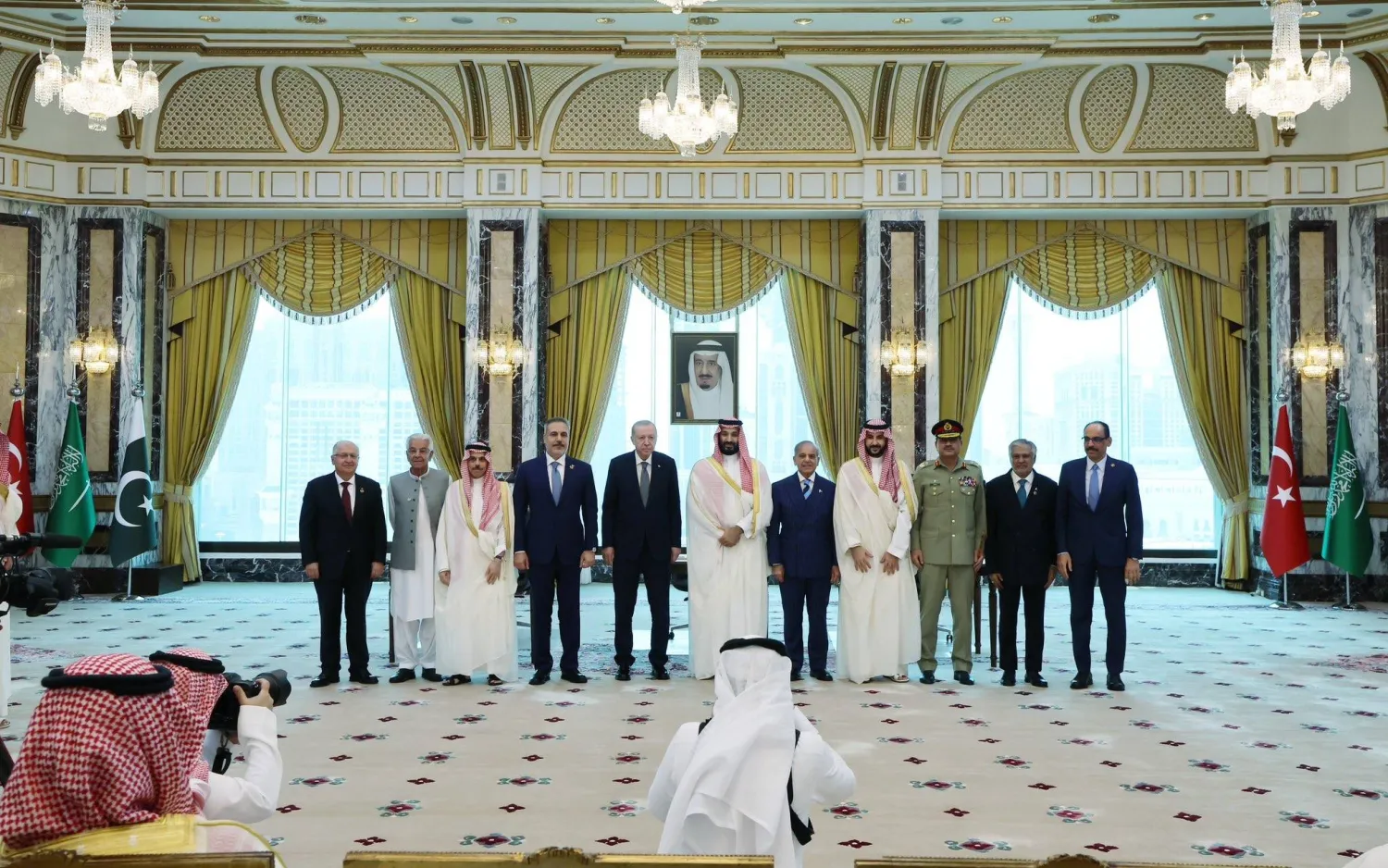
Official mobility has a security architecture that needs to be understood if one is to understand why it is important. The Strategic Mutual Defence Agreement, which is based on the concept of aggression against one is aggression against both, was signed by both countries on 17th September, 2025. The Makkah Joint Defence Agreement was signed by Crown Prince Mohammed bin Salman, President Recep Tayyip Erdoğan and Prime Minister Shehbaz Sharif on August 7, 2026. It is meant to reinforce “collective deterrence” and states that an armed attack on any one of the three states is an attack on all three.
This is an interesting development. The Gulf’s security model for decades was based on outside guarantors. They have created a trilateral partnership of Saudi capital and geography, Turkish depth in defence industry and Pakistani manpower and experience in the military, toward a more self-reliant model. It reads that about 8,000 Pakistani personnel, aircraft and air-defence systems are already operating in the Kingdom of Saudi Arabia as part of the Saudi–Pakistan relationship. Meanwhile, Riyadh is making a concerted effort to make its defense industry more locally based, while Pakistan and Türkiye already have expanding defense-industrial and military cooperation. Those are complementary not duplicated strengths.
What role does mobility play in deterrence?What is the importance of mobility in deterrence?
Alliances are usually measured by their signatures, and hardware. So they do live and breathe on routine coordination – joint planning, procurement discussions, exercises, intelligence liaison, and crisis consultations – on the spur of the moment. Both demand the officials to travel at a fast pace on a frequent basis. A visa waiver for passports issued to diplomats and others with special purpose passports does away with that “friction” in just that layer of cooperation.
There’s also a “signaling value” Partners need to act as a team in order to deter. Small, pragmatic understandings to get official business done regularly make the greater commitment more believable. A pact which is on paper only invites doubt—working-level habits enclose a pact and do not. This is no abstract issue of credibility; the Makkah agreement was made during a time of conflict in the region that saw strikes in Saudi Arabia.
A Challenge to the Conventional View
The mainstream interpretation of all bilateral operations within a multilateral platform as a “zero sum” message is flawed, as it ignores the fact that Ankara and Riyadh are not the only ones to benefit. This is the mindset of alliance politics of the twentieth century. Partnerships are different in today’s network era. They develop by connecting in a bilateral way, then overlapping and eventually forming a whole. The “triangle” can grow stronger as each side grows thicker, and the rapid expansion of relations between Saudi and Türkiye as well as Pakistan and Türkiye can take their own pace.
If the visa waiver is viewed in this manner, then it’s a component of a building block. What comes next is the constructive question for policy makers, for who was “skipped” does not truly matter. A mobility framework, which fully reflects these arrangements, has not been publicly reported on the Pakistan–Turkey side. Closing it would be a low cost but a high-practical-value move, as there would be an official and defence-related travel facility in all three capitals.
Sensible Boundaries, Reasonable Solutions
The assessment should also not be flattering. The full text of the Makkah agreement has not been published in full; there is primarily only official text. Some analysts say that it’s more important for it to be a capacity building than an automatic military trigger. Its impact has been challenged by critics, such as an Iranian parliamentarian and Israeli minister. These are legitimate concerns, and they set the future course for the three states to prove themselves: what they have to show in action.
There were three steps to making promise into performance. To establish a permanent institutional base for the trilateral framework, first create a standing coordination mechanism, like a joint secretariat or regular defence ministers’ council. Second, focus on defence industrial projects which support the Saudi localization agenda and Turkish and Pakistani capabilities such as co-production and joint maintenance projects. Third, expand official mobility arrangements to all pairs of members so that there are no weaker ties in the mobility triangle than other ties.
Conclusion
The question posed in the headline was: Was Pakistan skipped? The more pertinent question is: Are three states building an enduring security community? The evidence is that they are that one by one, they have made agreements: a defence pact in Makkah, a waiver in Ankara, a matching waiver in New York. Dramatic is a non-dramatic. Together, they’re painting a picture of an area where partners are cultivating a culture of cooperation instead of relying on external protection. That’s the development to watch for security studies

Waqas Abdullah is a geopolitical analyst and anthropologist area of experties in Middle Eastern and Indo-Pacific politics. A Türkiye Bursları Scholar, he is pursuing a Master’s in International Relations at Selçuk University Konya ,Türkiye. His work focuses on climate refugees, human security, and regional cooperation.