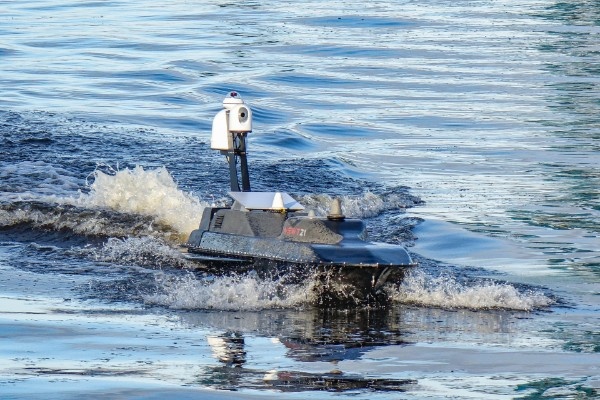

UAV Navigation–Grupo Oesía has successfully demonstrated its advanced autonomous maritime control system during maritime exercises conducted by the U.S. Special Forces in Cartagena, Spain. The system was deployed aboard the FOG Unmanned Surface Vehicle (USV) platform developed by NEWT21, highlighting the growing operational maturity of autonomous naval technologies.
Table of Contents
ToggleAutonomous Maritime Control System Proves Operational Reliability
The exercises provided a demanding real-world environment to validate the performance of the autonomous maritime control system under operational stress. The USV executed a fully autonomous navigation profile, demonstrating stable maneuvering, precise route tracking, and resilience in complex maritime conditions.
Among the key capabilities demonstrated were dynamic relative routing, accurate waypoint navigation, and advanced collision-avoidance systems, particularly during mothership approach operations. These capabilities are critical in contested maritime environments where rapid, autonomous decision-making is essential.
The system’s fault-tolerant architecture, combined with integrated health-monitoring functions, ensured uninterrupted operations despite environmental challenges. This significantly enhances mission assurance, operational safety, and platform survivability in high-risk scenarios.
Expanding Role of Autonomous Systems in Maritime ISR
The successful validation reinforces the increasing reliance on autonomous maritime systems for intelligence, surveillance, and reconnaissance (ISR) missions. Unmanned Surface Vehicles equipped with advanced autonomy provide persistent situational awareness across large maritime domains, improving operational efficiency for naval forces.
By reducing dependence on crewed platforms, autonomous systems minimize personnel risk while extending mission endurance. This is particularly relevant in hybrid threat environments and contested waters, where unmanned platforms can operate with reduced vulnerability.
Additionally, these systems support a wide range of missions, including maritime patrol, reconnaissance, logistics support, and force protection, underscoring their versatility in modern naval operations.
Industry Collaboration Driving Next-Generation Naval Capabilities
The collaboration between UAV Navigation–Grupo Oesía and NEWT21 played a critical role in achieving successful outcomes during the exercises. The integration of advanced guidance, navigation, and control (GNC) technologies with high-performance USV platforms reflects a broader shift toward software-driven defense solutions.
Both organizations emphasized that close industrial cooperation is essential for accelerating innovation and delivering mission-ready autonomous capabilities. The demonstrated success highlights the maturity and scalability of next-generation unmanned maritime systems.
Autonomous Naval Warfare and Future Operational Trends
The demonstration signals a broader transformation in naval warfare, where autonomous and unmanned systems are becoming central to operational doctrine. Defense forces worldwide are increasingly investing in such technologies to enhance flexibility, scalability, and mission effectiveness.
Autonomous maritime control systems enable rapid response to emerging threats while minimizing human exposure in high-risk environments. With continued advancements in artificial intelligence, sensor integration, and autonomous navigation, USVs are expected to play a decisive role in future maritime operations.