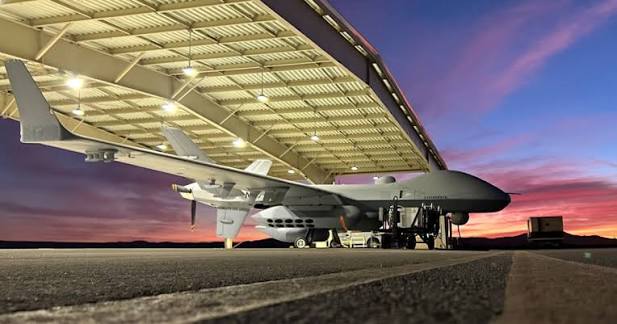

The U.S. Navy has evaluated the MQ-9B SeaGuardian unmanned aircraft system at Naval Air Station Whidbey Island as it continues to assess the platform’s potential role in maritime patrol, reconnaissance and anti-submarine warfare operations.
General Atomics Aeronautical Systems Inc. (GA-ASI) presented the MQ-9B SeaGuardian during the Maritime Patrol and Reconnaissance Force Commander’s Operational Group at Naval Air Station Whidbey Island in Washington.
The event brought together senior Maritime Patrol and Reconnaissance Force leaders, operational personnel, tacticians and industry representatives to review emerging naval aviation capabilities and current anti-submarine warfare tactics, techniques and procedures.
Table of Contents
ToggleMQ-9B SeaGuardian Supports U.S. Navy Capability Assessment
SeaGuardian is the maritime-focused variant of the MQ-9B remotely piloted aircraft family developed by General Atomics.
The U.S. Navy currently operates the aircraft under a company-owned, company-operated arrangement with GA-ASI as part of an ongoing capability assessment supporting U.S. 7th Fleet requirements.
Under this model, GA-ASI owns and operates the aircraft while providing the service to support Navy evaluation and operational experimentation.
The arrangement allows the Navy to assess the platform in realistic maritime environments without first establishing a fully organic operational fleet.
SeaGuardian Displayed Alongside P-8A Poseidon
GA-ASI brought the SeaGuardian to Whidbey Island at the request of Commander, Patrol and Reconnaissance Group.
The aircraft was displayed alongside the Boeing P-8A Poseidon, the U.S. Navy’s principal crewed maritime patrol and anti-submarine warfare aircraft.
The pairing illustrates the broader concept under evaluation: using long-endurance unmanned aircraft alongside crewed maritime patrol platforms to expand surveillance coverage, improve persistence and distribute intelligence, surveillance and reconnaissance tasks across a wider operational area.
Patrick Shortsleeve, GA-ASI Vice President of DoD Strategic Development, said the appearance gave Maritime Patrol and Reconnaissance Force personnel an opportunity to examine the aircraft in a naval aviation environment.
“Whidbey Island is a great place to display SeaGuardian alongside the P-8A Poseidon for MPRF professionals to help illustrate that this future-focused capability is here now and ready for employment,” Shortsleeve said.
Maritime Surveillance and ASW Potential
The MQ-9B SeaGuardian has been developed for long-endurance maritime intelligence, surveillance and reconnaissance missions.
Its endurance and sensor capacity make the platform suitable for persistent coverage over large maritime areas, particularly where continuous crewed aircraft presence may be operationally demanding.
For the U.S. Navy, the aircraft is being examined as a possible force multiplier for the Maritime Patrol and Reconnaissance Force.
Potential missions include maritime domain awareness, surface surveillance, intelligence collection and support for anti-submarine warfare operations.
In an ASW environment, unmanned platforms can potentially extend the surveillance reach of existing patrol aircraft and surface forces while providing persistent sensor coverage across strategically important maritime areas.
The SeaGuardian is not intended simply as a replacement for crewed maritime patrol aircraft such as the P-8A. Instead, the Navy’s evaluations are examining how unmanned and crewed platforms could operate together as part of a broader distributed maritime surveillance architecture.
Role in Distributed Maritime Operations
Long-endurance unmanned aircraft are becoming increasingly important as navies seek to monitor larger areas with fewer crewed assets.
Platforms such as the MQ-9B can remain airborne for extended periods and provide commanders with persistent ISR coverage, potentially allowing high-value crewed aircraft to focus on missions requiring greater onboard processing, tactical decision-making or weapons employment.
For the U.S. Navy, this type of crewed-uncrewed integration could become increasingly relevant in the Indo-Pacific, where operational distances and the size of the maritime environment create significant surveillance challenges.
The current SeaGuardian assessment supporting the 7th Fleet reflects this operational requirement.
A remotely piloted aircraft capable of conducting extended maritime patrols could increase the amount of time sensors remain on station while also supporting other aircraft, warships and command-and-control nodes with additional surveillance data.
Whidbey Island Remains Important to SeaGuardian Testing
Naval Air Station Whidbey Island has previously supported U.S. Navy evaluations involving the MQ-9B SeaGuardian.
The platform has participated in Navy exercises and experimentation activities including Northern Edge and Integrated Battle Problem.
These events have allowed the service to examine how unmanned aircraft can contribute to broader naval operations and integrate with existing command, sensor and combat systems.
SeaGuardian has also supported U.S. Navy aircraft carrier pre-deployment workups.
Its latest appearance at Whidbey Island therefore forms part of a wider series of evaluations rather than a standalone demonstration.
The aircraft was also displayed during the Whidbey Island Open House in 2025.
MQ-9B Expands Maritime Aviation Role
The SeaGuardian is a maritime adaptation of General Atomics’ MQ-9B platform, incorporating capabilities intended for over-water surveillance and naval operations.
Beyond the U.S. Navy, variants of the MQ-9B family have attracted international interest as operators seek persistent intelligence and surveillance capabilities with lower crew requirements than traditional patrol aircraft.
GA-ASI has positioned SeaGuardian for missions ranging from maritime surveillance and border monitoring to anti-submarine warfare support.
For the U.S. Navy, however, the current evaluation remains focused on determining how the aircraft could complement the wider Maritime Patrol and Reconnaissance Force.
Further testing will help define the extent to which the SeaGuardian can be incorporated into future naval aviation concepts, particularly those centered on distributed operations, persistent surveillance and closer integration between crewed and uncrewed aircraft.