
In modern defense and security operations, situational awareness is only as effective as the ability to see and interpret the operational environment. While advances in sensors, artificial intelligence, and autonomous systems have transformed military capabilities, degraded visibility caused by fog, rain, dust, smoke, and darkness continues to challenge operators across land, maritime, and unmanned domains. Addressing this persistent operational gap has become increasingly critical as defense forces seek to maintain decision superiority in complex environments.
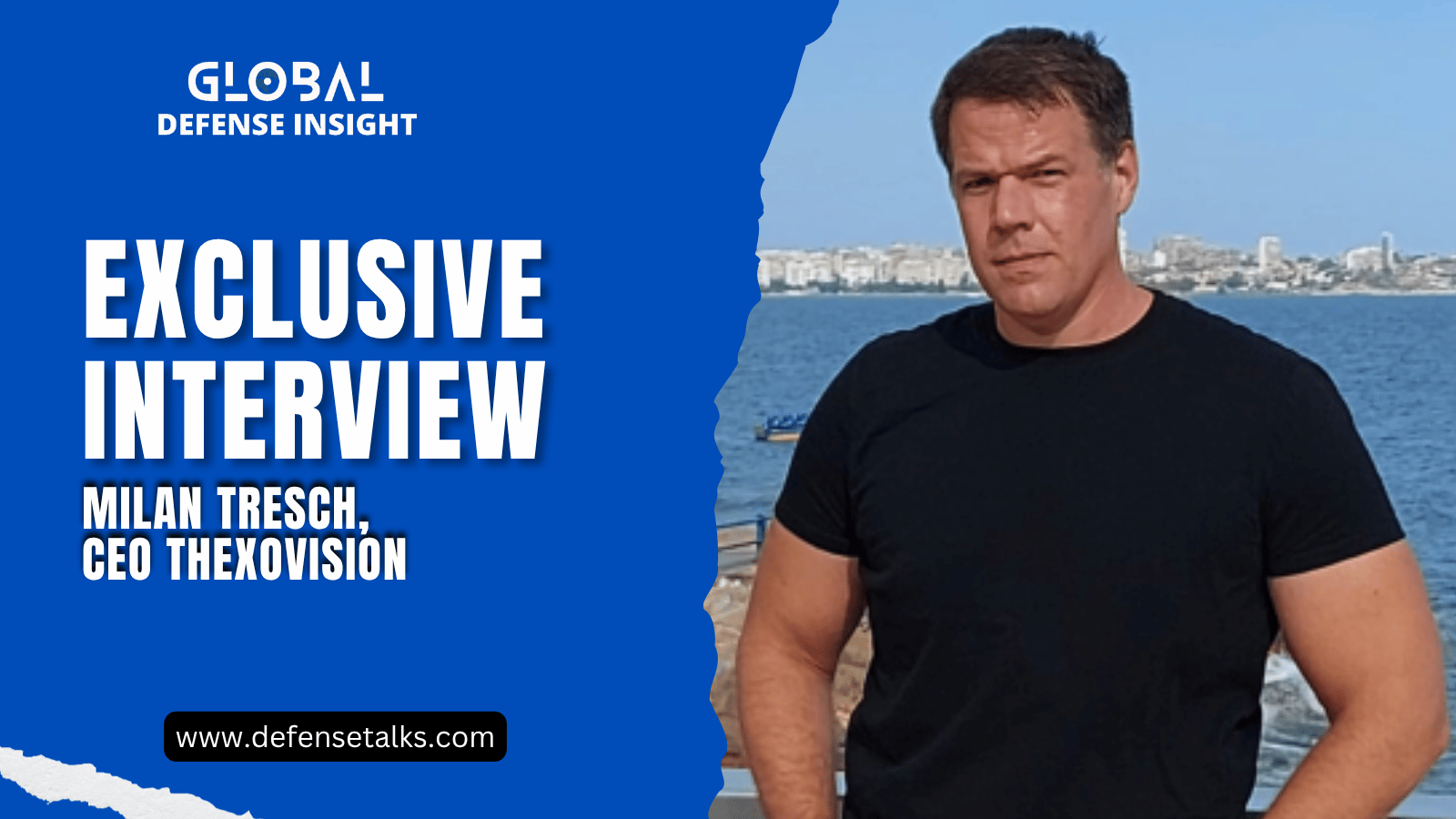
Founded with a focus on real-time visibility enhancement, THEXOVISION is developing technologies designed to improve visual awareness in adverse conditions without requiring operators to replace existing electro-optical infrastructure. In this exclusive interview with Global Defense Insight, Milan Tresch, CEO of THEXOVISION, discusses the evolution of the company’s SightBooster technology, its growing role in defense and security applications, the integration of AI-enabled systems, and the strategic vision driving THEXOVISION’s expansion across global markets.
- SightBooster enhances visibility in fog, rain, snow, and darkness in real time. What operational gap in modern defense and surveillance systems does it close, and why has that gap been so difficult to solve until now?
Modern defense and surveillance systems have become extremely advanced in terms of sensors, autonomy, and data processing, yet one very practical problem remains persistent: operators still lose visual effectiveness in degraded environments such as fog, heavy rain, snow, smoke, sea haze, dust, or low-light conditions.
SightBooster was developed to address that operational visibility gap in real time. The objective is not simply to “improve image quality,” but to help maintain situational awareness and operational continuity when environmental conditions reduce the usefulness of standard optical systems.
Historically, this has been difficult because degraded visibility is highly dynamic. Atmospheric conditions scatter and distort light differently depending on weather, distance, motion, sensor type, and available illumination. Traditional image enhancement methods often introduce latency, artifacts, or require controlled environments that are not realistic for operational deployment.
Our approach focuses on low-latency enhancement that can operate alongside existing camera infrastructure and support real-time decision-making in mission-critical environments.
- You have moved from marine reconnaissance with Medirlab’s Jumbo Marine system to land-based border surveillance with DJ Byers’ Presidian vehicle. How does the same core technology adapt across such different environments and which domain do you see as the biggest growth opportunity?
The core operational challenge is very similar across maritime, border security, reconnaissance, and unmanned environments: maintaining reliable visual awareness when environmental conditions begin to degrade.
In maritime and coastal operations, operators often face sea fog, haze, humidity, glare, spray, and long-range observation limitations. In land-based defense and border surveillance environments, the challenges may involve rain, dust, terrain visibility, low-light observation, or mobile deployment in remote areas. The environmental conditions differ, but the operational requirement remains the same — preserving situational awareness and visual confidence under difficult conditions.
What makes SightBooster adaptable is that it was designed as a software-based enhancement layer that can integrate with existing electro-optical, reconnaissance, and real-time video communication systems rather than replace them. This allows the technology to operate across different mission profiles, from Medirlab’s electro-optical and marine reconnaissance environments, to HYTEC INTER’s low-latency mission-critical video systems, as well as fixed and mobile defense observation platforms such as the HAWKEYE real-time reconnaissance and surveillance solution and DJ Byers’ Presidian border surveillance vehicle.
We also see increasing relevance in unmanned and remotely operated systems, where operators rely entirely on sensor feeds for navigation, detection, and decision-making. In many ways, degraded visibility becomes even more critical when there is no direct human line of sight to the operational environment.
- Your software offers visibility enhancement in the visible spectrum as a complement, and sometimes an alternative, to thermal IR night vision. In what scenarios should an operator choose your approach over established IR solutions, and where do the two work best together?
Thermal systems remain extremely important and, in many cases, irreplaceable, especially for detection in complete darkness or identifying heat signatures through certain obscurants.
However, visible-spectrum enhancement still offers major operational advantages because it preserves natural scene interpretation, object detail, terrain understanding, markings, navigation references, and human-readable visual information that thermal systems do not always provide.
In many real-world environments, operators benefit most when visible-spectrum enhancement and thermal imaging are used together. Thermal systems can support detection, while enhanced visible-spectrum imaging can improve recognition, navigation, orientation, and overall situational interpretation.
Rather than viewing the technologies as competitors, we see them as complementary layers within modern electro-optical systems. This is particularly relevant for maritime operations, border security, mobile reconnaissance, and unmanned platforms where operators require both detection capability and environmental context.
- THEXOVISION is a small, specialized firm in a market dominated by large defense primes. How do you position yourselves competitively, and what does your partnership and integration model allow you to achieve that going direct could not?
We position THEXOVISION as a specialized operational technology company focused on a very specific challenge: real-time visibility enhancement in degraded environments.
Large defense organizations often operate across extremely broad portfolios. Our advantage is the ability to focus deeply on one operational problem and develop solutions that can integrate into existing systems rather than requiring entirely new architectures.
Our partnership and integration approach is therefore very important. Working alongside companies such as Medirlab, and engaging with organizations involved in tactical communications, reconnaissance, and mission-critical video systems, allows us to adapt our technology to operational realities more effectively than attempting to build complete end-to-end defense platforms ourselves.
This model also supports interoperability and faster deployment, because many defense and security operators prefer solutions that can enhance existing infrastructure and electro-optical investments rather than replace them entirely.
- You joined Portugal’s AED Cluster and established an R&D subsidiary there with a focus that includes the subsea domain. What strategic role does Europe play in your roadmap, and how are you navigating defense procurement and export considerations across multiple countries?
Europe plays a very important role in our roadmap because it combines strong defense-industrial capabilities with increasing investment in dual-use technologies, maritime security, autonomy, border protection, and resilient infrastructure.
Portugal is strategically interesting for us not only because of the AED Cluster ecosystem, but also because of the country’s maritime orientation and growing interest in advanced defense and subsea technologies.
At the same time, we remain realistic about the complexity of defense procurement and export processes. As a smaller technology company, partnerships and local industrial relationships are essential. Different countries have different operational requirements, certification pathways, and procurement structures, so collaboration with established integrators and regional partners becomes critical for scaling internationally.
Our objective is to remain technologically flexible while ensuring compliance with national and international regulatory frameworks.
- As AI-based tracking and unmanned systems become standard across defense platforms, how does real-time visibility enhancement fit into that stack — as a force multiplier for autonomy, sharper input for AI detection, or both?
We believe it is both.
Autonomous systems and AI-based detection models are fundamentally dependent on sensor quality. If visibility degrades, the quality of both human and machine interpretation can degrade as well.
Real-time visibility enhancement can therefore operate as a foundational support layer that improves the quality of incoming visual information before higher-level analysis or autonomous decision-making occurs.
This can benefit human operators directly, but it can also support AI-assisted detection, tracking, navigation, and situational analysis by improving visual clarity in challenging environmental conditions.
As unmanned systems continue to expand across maritime, aerial, and land domains, maintaining reliable sensor performance in degraded environments will become increasingly important.
- Looking three to five years ahead, where do you want THEXOVISION to be in the global defense ecosystem, and are there emerging demands such as counter-drone operations that are shaping your development priorities?
Over the next three to five years, we want THEXOVISION to become a recognized specialist in operational visibility enhancement for mission-critical environments across defense, maritime, security, and unmanned systems.
Our goal is not necessarily to become a large defense prime contractor, but rather to establish ourselves as a trusted technology layer that can integrate into a wide range of electro-optical and surveillance platforms globally.
We also see growing relevance in areas such as counter-drone operations, autonomous navigation, remote reconnaissance, maritime domain awareness, and persistent border surveillance. In many of these environments, operators and autonomous systems face increasing pressure to function continuously despite weather and environmental limitations.
Ultimately, we believe visibility itself is becoming a strategic operational capability. Systems may continue to evolve, but the ability to reliably see, interpret, and react under degraded conditions will remain fundamental.