
The Iran war that began in February 2026 has exposed a specific weakness in Gulf defense planning: the region possesses advanced missile-defense systems, but not necessarily a cost-effective means of sustaining them through protracted operations.
Countries such as Saudi Arabia, the United Arab Emirates (UAE), Qatar, Kuwait, Bahrain, and Oman have invested heavily in Patriot, THAAD, and other high-end systems. Nevertheless, a conflict involving a combination of ballistic missiles, cruise missiles, one-way attack drones, decoys, and unmanned maritime systems cannot be managed by advanced interceptors alone.
The central challenge is interceptor economy: determining which threats necessitate expensive missiles, which can be addressed with more affordable weapons, and how quickly depleted stockpiles can be replenished.
To be sure, systems such as Patriot and THAAD remain essential for countering the most dangerous threats. However, deploying multimillion-dollar interceptors against every drone and decoy is both financially and operationally unsustainable. In a prolonged conflict, interceptor stockpiles could diminish faster than foreign suppliers can replenish them.
This is South Korea’s opportunity.
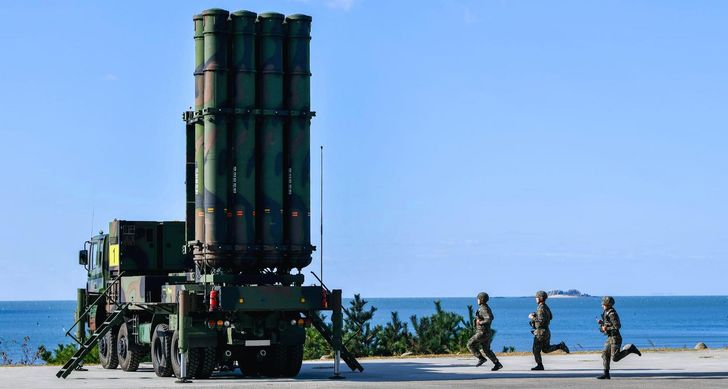
Instead of marketing systems such as Cheongung-II, Chunmoo multiple-launch rocket system (MLRS), the K9 self-propelled howitzer, and counter-unmanned aircraft systems (C-UAS) separately, South Korean firms should offer packages designed around specific assets. Oil terminals, LNG facilities, air bases, ports, and border corridors could be the primary candidates. Each package should clearly identify which sensors would detect threats, which weapons would engage them, and how munitions and equipment would be restored to operational readiness.
At present, South Korea does not possess every component of an integrated C-UAS architecture. South Korean firms should therefore integrate their systems with selected foreign and local technologies. Moreover, each proposal requires a clearly designated lead integrator rather than separate, competing offers from South Korean companies.
The message should also be straightforward: South Korean systems would not replace the US shield. Rather, they would reduce the likelihood that US interceptors would need to be fired.
Saudi Arabia: Protecting the Eastern Energy Corridor
Because of its scale, immediate exposure to threats, and strong demand for localization, Saudi Arabia should be South Korea’s priority market. The kingdom has already ordered Cheongung-II interceptors. South Korea’s next proposal should focus on the eastern energy corridor, including the oil, petrochemical, and export facilities around Ras Tanura and Dammam.
The first priority should be sustaining Cheongung-II. This should include additional interceptors, testing equipment, experienced operational personnel, spare parts, and depot-level maintenance. Follow-on units could protect infrastructure clusters where systems such as Patriot and THAAD cannot provide continuous coverage. The second priority should be C-UAS defenses linking low-altitude radar, electro-optical identification systems, and low-cost kinetic effectors.
Chunmoo could provide counter-launch capabilities against identified drone-staging areas, proxy rocket positions, and coastal missile units. It would, however, be effective only as part of an intelligence, surveillance, and reconnaissance-to-fire system involving surveillance, target acquisition, and command authorization. Meanwhile, platforms such as the K9 and K10 ammunition resupply armored vehicle (ARV) should be presented separately as part of Saudi ground-force and counter-fire modernization.
Localization should begin with maintenance, training, and ammunition inspection before advancing toward selective assembly and component production. Core technologies should remain under South Korean control.
UAE: Building a Regional Testing and Support Center
The UAE should be treated as South Korea’s regional partner for technology development and support. The UAE already operates Patriot, THAAD, and Cheongung-II systems and must defend exceptionally high-value sites, including Al Dhafra Air Base, the Barakah nuclear power plant, Ruwais, and Jebel Ali.
South Korea’s initial proposal should be a joint low-altitude defense-testing program with EDGE Group. Emirati and South Korean companies could select a port or energy facility and test a combination of radar, passive detection, electronic warfare, drone interception, and short-range effectors. This could generate operational data under Gulf conditions and produce exportable systems that would be more credible than an untested package.
Additional Cheongung-II interceptors and follow-on units could be more practical in the short term than the immediate promotion of L-SAM batteries, which could overlap operationally with THAAD. The long-term objective should be to establish Emirati maintenance, simulation, and testing centers supporting South Korean air-defense and C-UAS systems throughout the region.
Kuwait: Beginning with a One-Port Defense Pilot
Kuwait is deeply integrated into US military infrastructure. Therefore, any proposal to replace Patriot, NASAMS, Integrated Battle Command System (IBCS), or US command systems would be inappropriate.
The most realistic entry project would be a point-defense system at either Shuaiba or Mina al-Ahmadi. Low-altitude radar, electro-optical sensors, electronic-warfare systems, mobile guns or short-range effectors, a local command post, and South Korean maintenance support could be deployed at the selected site.
Only after such a pilot project had demonstrated its value should Cheongung-II be considered for selected regions of Kuwait. The initial command node would likely remain under Kuwaiti state control while exchanging only approved warning data with US systems. Comprehensive integration with IBCS should not be guaranteed in advance. Kuwait’s commercial value lies primarily in maintenance, spare-parts stockpiling, ammunition supply, and readiness contracts.
Qatar: Separating Al Udeid from LNG Defense
Qatar’s defense requirements should not be treated as a single issue. Al Udeid Air Base is closely integrated with US regional operations, meaning that any deployment of South Korean systems around the base would require consultation with Washington. Qatar’s LNG facilities, ports, and civilian infrastructure could offer more practical entry points.
South Korea should therefore begin with a defense package for Ras Laffan, Hamad Port, or another LNG-related infrastructure cluster. This package should combine C-UAS sensors, electronic-warfare systems, hardened command facilities, repair support, and low-cost effectors. A limited Cheongung-II deployment could strengthen Qatar’s sovereign air-defense layer. The central argument should be that Qatar requires additional capabilities to protect its national infrastructure, rather than that South Korean equipment could defend US bases.
Bahrain: Defending a Dense Urban Battlefield
Bahrain’s airports, ports, energy infrastructure, government facilities, and the US Fifth Fleet are all concentrated within a densely populated area.
The priority should be to deploy compact systems capable of detecting drones earlier and engaging them within controlled zones. The objective should not be to guarantee zero collateral damage, but rather to reduce dependence on large interceptors within metropolitan airspace.
The Bahrain package should cover Naval Support Activity (NSA) Bahrain, Mina Salman, Bahrain International Airport, low-altitude sensors near Sitra, electronic-warfare systems, drone interceptors, and locally controlled engagement nodes.
Oman: Connecting Duqm, Sohar, and Salalah
Oman should not be presented with an explicitly anti-Iranian package. Its balanced and independent diplomacy and geographical position near the Strait of Hormuz make maritime continuity a more acceptable entry point. South Korea should instead propose connecting coastal sensors across Duqm, Sohar, and Salalah to create a common maritime operating picture. The network could monitor commercial shipping, drones, suspicious small vessels, and unmanned maritime threats.
Port-level C-UAS systems, mine-countermeasure capabilities, patrol vessels, and unmanned maritime platforms could then be added incrementally. Meanwhile, Cheongung-II should remain an optional long-term system. The primary proposal should focus on maintaining port operations and ensuring safe passage, especially during a crisis in the Strait of Hormuz.
Iraq: Making Cheongung-II Operational
In Iraq, South Korea should focus on making the existing Cheongung-II acquisition fully operational. Training, maintenance, ammunition control, spare-parts management, and national command procedures may be more important than selling another platform. Additional sales should depend on whether Iraq can demonstrate centralized state control, secure ammunition storage, and acceptable levels of readiness.
Jordan: Developing a Border-Defense Testing and Training Hub
Jordan’s immediate requirement is likely to be mobile C-UAS and surveillance capabilities along its borders with Syria and Iraq. South Korean firms could offer radar, electro-optical systems, electronic-warfare systems, mobile guns, and command vehicles. Chunmoo should not be a short-term priority. Rather than serving primarily as a customer for long-range fires, Jordan could function as a testing and training market for cost-effective border-defense systems.
Building a Two-Hub Sustainment System
These country-specific packages should be connected through a regional support architecture.
Saudi Arabia could host large-scale maintenance facilities for Chunmoo, the K9, and ammunition-related systems. The UAE could host air-defense testing, electronic-warfare support, C-UAS development, and regional training. Kuwait, Qatar, Bahrain, Oman, and Jordan should maintain nationally controlled stocks of spare parts, repair modules, and selected munitions. This arrangement would allow these countries to preserve their sovereignty while enabling South Korean technicians and regional hubs to provide surge support during contingencies.
The Gulf region does not simply need more interceptors. It needs an engagement system that determines which sensor detects a threat, which weapon engages it, which interceptors are preserved, and how the system is restored to operational readiness. South Korea’s most consequential market position, therefore, would not be that of another arms supplier. It would be that of a regional partner in interceptor economy, local sustainment, and wartime endurance.

Dr. Ju Hyung Kim
Dr. Ju Hyung Kim serves as President of the Security Management Institute, a defense-focused think tank affiliated with South Korea’s National Assembly. He has contributed to numerous defense initiatives and has advised key institutions, including the Republic of Korea Joint Chiefs of Staff.